The Power of No: How Selective Wardrobing Reveals Your Most Refined Self
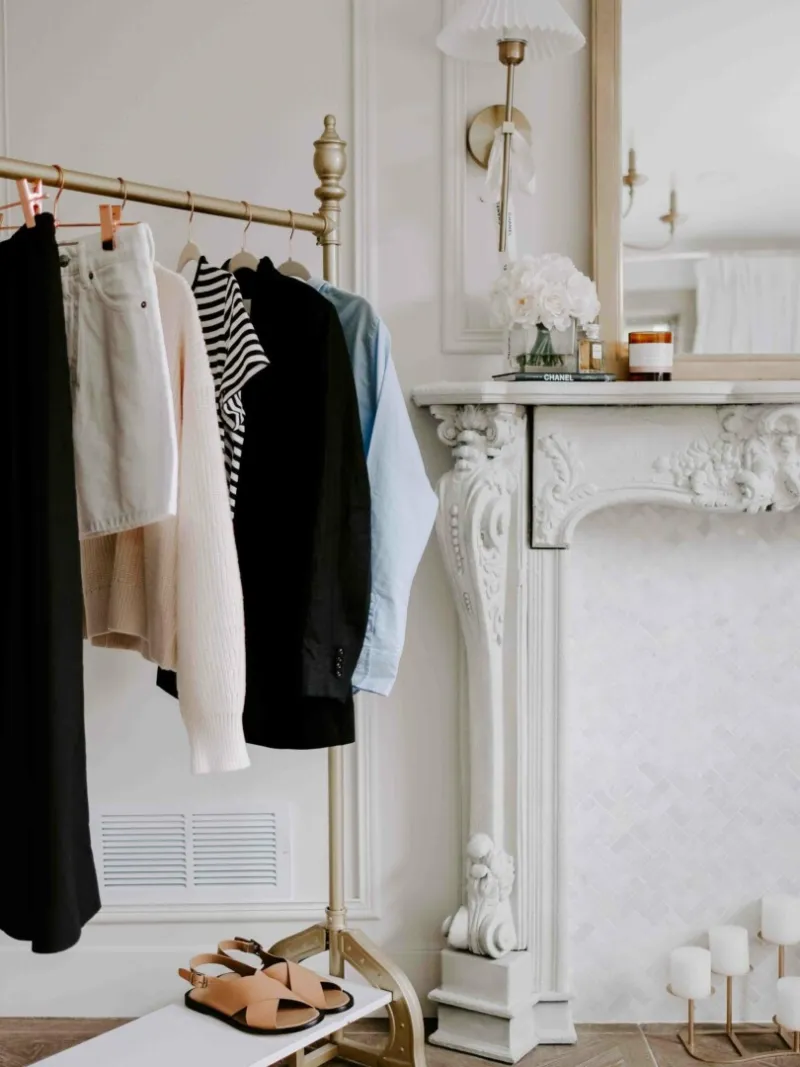
Photo: elegant woman minimalist luxury wardrobe closet curated fashion, via www.mychicobsession.com
There is a particular kind of confidence that cannot be purchased in a single transaction. It is built slowly, through a series of conscious decisions—and, more importantly, through a series of conscious refusals. In the world of luxury fashion, the most compelling wardrobes are not those that contain the most; they are those that contain only what is precisely, deliberately right.
At Aadhya Boutique, curation is not merely an aesthetic principle—it is a philosophy. And nowhere is that philosophy more personally transformative than in the practice of selective consumption: the discipline of saying no to everything that does not serve your highest vision of yourself.
The Tyranny of Trend Culture
The fashion industry, even at its most elevated levels, is not immune to the relentless churn of trend cycles. Luxury houses release runway collections that generate immediate cultural conversation, and the pressure to participate—to be seen wearing what is new, what is now—can be surprisingly acute, even among the most discerning shoppers.
Yet trend-chasing carries a hidden cost that extends well beyond the financial. Each piece acquired in pursuit of relevance rather than resonance dilutes the coherence of a wardrobe. Over time, a closet filled with reactive purchases tells no singular story. It reflects the fashion moment rather than the person who inhabits it.
The editors, stylists, and true connoisseurs of dress who have cultivated genuinely iconic personal styles share a common trait: they are remarkably unbothered by what is trending. They have identified the visual language that speaks most authentically for them, and they return to it with discipline. Trend reports are observed with curiosity, not urgency.
This is not rigidity—it is fluency. There is a meaningful difference between a person who cannot adapt and a person who has chosen not to be distracted.
Navigating Affluent Social Circles
Peer pressure does not disappear with income. If anything, it intensifies in circles where the stakes of appearance feel higher and the resources to act on impulse are readily available. Social gatherings among fashion-conscious, high-earning Americans can carry an unspoken currency of newness—the season's handbag, the just-released shoe collaboration, the jacket that signals membership in a particular aesthetic tribe.
Resisting this current requires a clarity of self that is, frankly, more difficult to cultivate than a high credit limit. It demands that you know precisely what you are dressing for—not what occasion or event, but what version of your life, your values, your aspirations.
When you have done that interior work, the social pressure loses much of its force. You are no longer measuring yourself against an external standard. The woman who arrives at a dinner in a beautifully cut three-year-old coat she loves completely is not behind the trend—she is beyond it. Her confidence is not borrowed from a label's current season; it is entirely her own.
The Mathematics of Meaning
Consider the practical arithmetic. A wardrobe of forty pieces, assembled without a governing principle, offers the illusion of choice while delivering daily frustration. A wardrobe of fifteen pieces, each selected with rigor and worn with genuine pleasure, offers something more valuable: clarity.
This is what the French concept of the capsule wardrobe gestures toward, though the American interpretation often misses the deeper point. The goal is not minimalism as aesthetic—sparse, colorless, deliberately austere. The goal is resonance. Every piece should earn its place by virtue of how it functions within the whole and how it makes you feel when you wear it.
Shopping, under this framework, becomes less frequent and far more intentional. The question is no longer Is this beautiful? or even Is this well-made? The question becomes Does this belong in the life I am building? That single reframe transforms the act of acquisition into something closer to an act of self-authorship.
Restraint as Luxury's Highest Expression
There is a reason the most revered luxury houses have always understood scarcity as a form of value. Limited production, long waitlists, discreet branding—these are not merely marketing strategies. They reflect an understanding that what is everywhere is, by definition, ordinary.
The same principle applies to personal style. A wardrobe edited to its essence communicates something that no amount of conspicuous consumption can replicate: that the person wearing it knows exactly who she is.
In that sense, the most luxurious thing you can do for your wardrobe—and for yourself—is to stop. Pause before the purchase. Sit with the desire. Ask whether the piece serves your vision or merely satisfies a momentary craving. More often than you might expect, the answer will surprise you.
And when the answer is yes—a genuine, considered, unhesitating yes—the acquisition carries a different weight entirely. Not the fleeting pleasure of novelty, but the lasting satisfaction of rightness.
Building the Practice
Selective wardrobing is not a destination but a discipline, and like any discipline, it improves with repetition. A few practices that the most intentional dressers return to consistently:
Define your aesthetic in writing. Not a mood board, not a Pinterest collection—words. Three to five adjectives that describe the visual impression you wish to make. When a potential purchase cannot be described by those words, it likely does not belong.
Impose a waiting period. For any non-essential purchase above a meaningful price threshold, wait seventy-two hours before completing the transaction. The items that still feel necessary after that interval are the ones worth owning.
Audit before you acquire. Before adding anything new, examine what you already have. Often, the desire for something new is actually a desire to wear something you already own differently.
Measure cost-per-wear honestly. A $600 blouse worn forty times costs $15 per wearing. A $120 blouse worn twice costs $60. Luxury, evaluated properly, is frequently the more economical choice.
At its core, selective wardrobing is an act of respect—for your resources, your time, and the singular person you are in the process of becoming. The wardrobe that results is not smaller than it might otherwise have been. It is simply, and entirely, yours.