The New Professional Canvas: Dressing With Intention in the Age of Remote Work

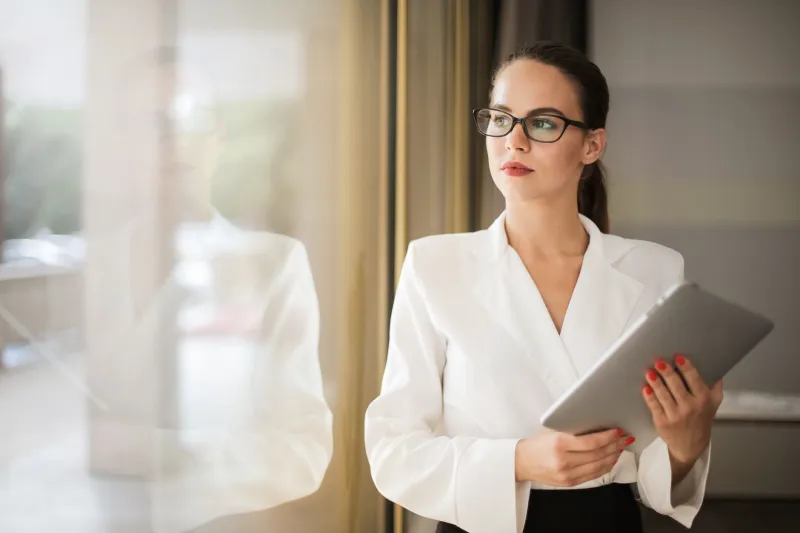
There was a time when dressing for work meant a single, well-understood code: the office. The commute, the conference room, the corridor — each setting informed the wardrobe, and the wardrobe, in turn, informed the woman wearing it. Then the boundaries dissolved. The living room became the boardroom. The kitchen counter became the backdrop for a negotiation. And somewhere in that shift, a quieter, more personal question emerged: Who are you dressing for now?
For those who have built careers on the currency of presence and polish, the answer has never been simpler — or more demanding. You are dressing, at last, entirely for yourself. And that, it turns out, requires a far more deliberate approach than dressing for an audience ever did.
The Psychology of the Private Uniform
Research in behavioral psychology has long supported what well-dressed professionals have always known intuitively: what you wear affects how you think, how you carry yourself, and how effectively you perform. The phenomenon, sometimes referred to as "enclothed cognition," suggests that garments carry symbolic meaning that influences the wearer's mental state — independent of whether anyone else is in the room.
This is precisely why the most accomplished remote professionals have not abandoned their wardrobes. They have refined them. The question is no longer what will others see? but rather what does this garment do for me? A beautifully constructed silk blouse worn at a home desk at 7 a.m. is not theater. It is architecture — a structure that supports focus, confidence, and the particular clarity that comes from treating one's own time as worthy of care.
At Aadhya Boutique, we have always believed that luxury dressing is fundamentally an act of self-regard. The hybrid work era has not complicated that belief. It has confirmed it.
What the Camera Demands — and What It Rewards
For all its intimacy, remote work has introduced a new and surprisingly exacting audience: the camera. Video calls have their own visual logic, and it is worth understanding before investing in pieces intended to carry professional weight in virtual settings.
The lens compresses and flattens, which means that texture and contrast become your most reliable allies. A flat, matte fabric in a mid-tone reads as absence on screen; a fine-gauge merino knit, a structured crepe, or a blouse with subtle surface interest reads as presence. Depth of color matters similarly — rich navy, warm ivory, deep burgundy, and forest green photograph with a natural authority that washed-out pastels rarely achieve under artificial light.
Necklines, too, deserve strategic consideration. Because video framing typically centers on the face and upper chest, the neckline functions as a frame within a frame. A well-chosen V-neck or a structured boat neck draws the eye upward and creates an impression of composure. Statement jewelry — a single sculptural earring, a refined pendant, a cuff that catches the light — translates beautifully on camera in a way that a full ensemble simply cannot.
Finally, and perhaps most importantly: fit. The camera has no patience for fabric that pulls, drapes awkwardly, or collapses at the shoulder. A garment that fits with precision signals, even through a screen, that the person wearing it operates at a level of exactitude worth attending to.
Building the Remote Work Wardrobe: A Framework for Investment
The most elegant approach to dressing for hybrid work is not to maintain two separate wardrobes — one for the office, one for home — but to curate a single, cohesive collection of pieces that perform across both contexts. This requires prioritizing a specific set of qualities.
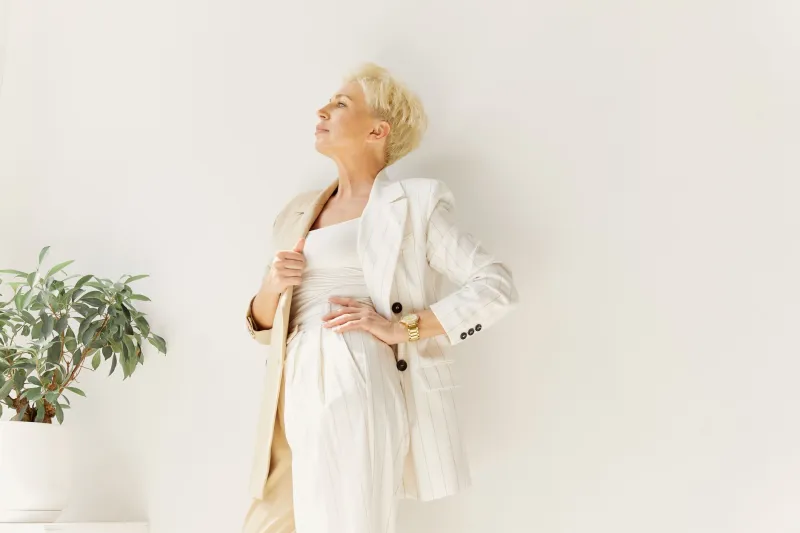
Elevated basics with structural integrity. A fine-knit turtleneck, a tailored blazer in a neutral, a crisp poplin shirt with impeccable seaming — these are the foundational pieces that read as professional without requiring effort. They do not announce themselves. They simply elevate everything around them.
Comfortable construction, not casual compromise. There is a meaningful distinction between a garment that is comfortable because it is well-made and one that is comfortable because it requires no thought. Seek the former. A pair of wide-leg trousers in a fluid wool blend, a relaxed blazer with a structured shoulder — these pieces honor the body without abandoning the standard.
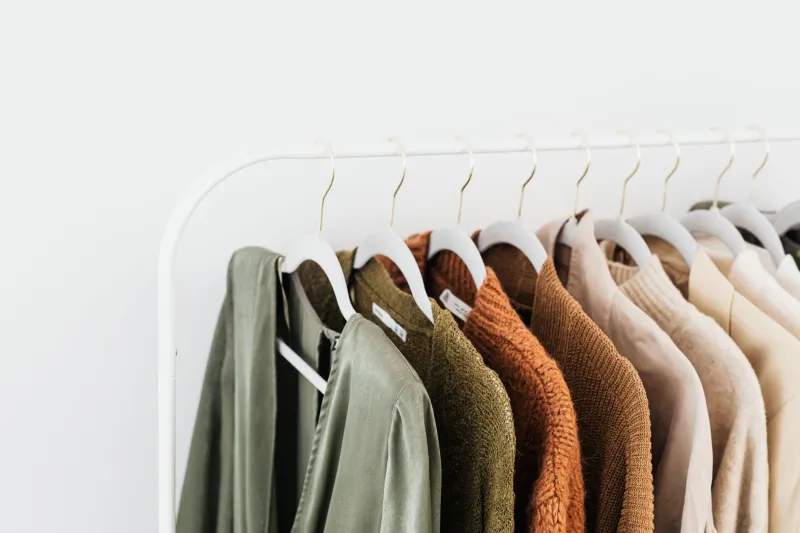
Camera-ready color stories. Rather than defaulting to whatever is at hand, consider building a small palette of two or three colors that you know photograph well under your specific home lighting. Test them. Observe how they read on screen. Then invest in several pieces within that palette so that getting dressed for a video call becomes an act of quiet confidence rather than guesswork.
Accessories as signature. In a world where the camera sees only a portion of what you are wearing, accessories carry disproportionate weight. A single exceptional piece of jewelry — a well-crafted pair of earrings, a bracelet of genuine material and design — communicates more on screen than an entire carefully considered outfit might. Invest accordingly.
The Ritual That Has Nothing to Do With Anyone Else
Perhaps the most overlooked dimension of remote work dressing is also the most important: the ritual itself. The act of getting dressed — deliberately, thoughtfully, with care for fabric and fit and the particular mood of the day — is a form of preparation that no amount of productivity software can replicate.
High-achieving professionals who work primarily from home consistently report that maintaining a morning dressing ritual, even on days with no scheduled calls, correlates with higher focus, greater creative output, and a stronger sense of personal agency. This is not coincidence. It is the enactment of a standard — a daily declaration that one's work, one's time, and one's self are worth the effort of showing up fully.
Dressing well at home is not about impressing the occasional colleague on a Tuesday morning call. It is about the private relationship between a woman and her own ambitions. It is about the signal she sends to herself before she sends it to anyone else.
The Considered Investment
As with all things at Aadhya Boutique, the approach we advocate is one of deliberate curation over accumulation. The remote work wardrobe does not need to be large. It needs to be precise. A handful of pieces chosen for their ability to perform across contexts — to look considered on camera, to feel luxurious against the skin during a long day of focused work, to carry the weight of professional identity without requiring constant thought — will always outperform a closet full of compromises.
The home office is not a lesser stage. For many professionals, it has become the primary one. Dress for it accordingly.