Dressed by Decision: The Strategic Case for Removing Fashion Choice from Your Daily Routine
There is a particular kind of confidence that announces itself without spectacle. It arrives not in the form of a new silhouette each Monday or a rotating cast of statement pieces, but in the quiet, unwavering repetition of a woman who has already decided — and decided definitively — what she wears. This is the luxury uniform effect, and it is reshaping how the most influential women in America approach their wardrobes.
The instinct may be to associate such deliberate restriction with austerity or creative limitation. In practice, the opposite is true. What looks like simplicity from the outside is, upon closer examination, the product of extraordinary discernment.
The Fatigue Nobody Talks About
Decision fatigue is a well-documented psychological phenomenon, yet its relationship to fashion remains curiously underexplored in mainstream style conversation. Every morning, the average professional woman makes dozens of micro-decisions before she has finished her first cup of coffee — and a disproportionate number of those decisions involve clothing. What to wear, whether it still fits the role she is stepping into that day, whether the combination reads as polished or overdone, whether the shoes are appropriate for the afternoon meeting that follows a morning of calls.
Each of these choices draws from the same finite cognitive reservoir that will later be called upon for negotiation, leadership, creative problem-solving, and strategic thinking. High-achieving women — the ones running companies, building practices, and shaping culture — have recognized this drain. And many have made the practical, almost clinical decision to eliminate it entirely.
This is not minimalism in the aesthetic sense. It is resource allocation in the most personal and elegant form.
What the Uniform Actually Is
The luxury uniform is not a single outfit worn on repeat. It is more accurately described as a personal framework — a tightly defined set of silhouettes, fabrics, and proportions that remain consistent regardless of occasion, season, or trend cycle. Within that framework, quality does the heavy lifting that variety once attempted.
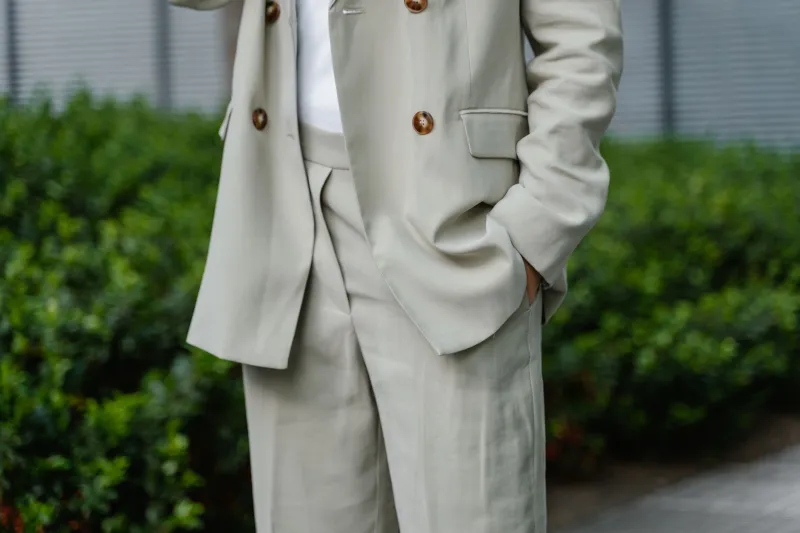
A woman operating within a luxury uniform might rotate between three impeccably tailored blazers, two pairs of wide-leg trousers in complementary neutrals, and a small selection of fine-knit tops that photograph beautifully and travel without effort. Every piece was chosen with surgical precision. Every combination works. Nothing requires deliberation.
The investment in individual pieces is typically higher — and deliberately so. When you are buying fewer things, the calculus shifts. You are no longer purchasing volume. You are purchasing certainty.
The Psychology of Wearing the Same Thing Well
There is a social dimension to the luxury uniform that deserves careful consideration. American professional culture has long celebrated visible variety in women's dress — the implicit expectation that a woman should appear refreshed and updated in her appearance across the workweek. The luxury uniform quietly, firmly, refuses this expectation.
What emerges in its place is something far more compelling: a signature. When a woman is recognized not by what she wore yesterday versus today, but by the consistent visual language she has cultivated over time, she has achieved something that trend-chasing cannot manufacture. She has become, in the truest sense, recognizable on her own terms.
This is not accidental. Research in behavioral psychology consistently supports the idea that perceived authority correlates with consistency of presentation. The woman who looks the same — poised, composed, intentional — on Tuesday as she does on Friday projects a stability that registers as confidence, competence, and control.
Identifying Your Uniform Before You Know You Need One
The challenge for most women is that the uniform reveals itself gradually, through years of returning to the same silhouettes and abandoning others. But there are ways to accelerate the process — and to do so with the kind of precision that transforms a wardrobe from a collection of clothes into a curated system.
Begin with your closet's evidence. Pull out what you actually wear, not what you aspire to wear. The pieces that survive every edit, that you reach for without thinking, that feel like yourself — these are the seeds of your uniform. Study them not just for style but for structure: What necklines recur? What fabrics? What heel height, what trouser break, what jacket length?
Identify the occasions that define your week. A woman who spends four days in client-facing meetings and one day working from home has a fundamentally different uniform requirement than one who splits her time between a creative studio and evening industry events. The uniform must be calibrated to actual life, not an idealized version of it.
Invest in fabric before silhouette. The luxury uniform lives or dies by the quality of its materials. A cashmere crewneck in the right weight will serve you across more situations — and more years — than a trend-driven blouse purchased at a fraction of the cost. When building toward a uniform, prioritize the tactile experience of what you are wearing. Fabric that moves well, photographs cleanly, and holds its structure through a long day is the foundation of everything.
Allow for exactly enough variation. The uniform does not require monotony. A deliberate palette — perhaps three to five colors that interact effortlessly — provides sufficient range for day-to-night transitions, seasonal shifts, and the occasional formal occasion, without introducing the paralysis of unlimited choice. Think of it as a well-edited menu rather than a single dish.
The Luxury Dimension
There is a reason the women most associated with this approach tend to gravitate toward investment-grade fashion. The luxury uniform is not merely a philosophical position; it is a practical one, and it demands pieces that hold up to the scrutiny of repetition.
A garment worn twice a week for three years must be constructed to withstand it — not just physically, but aesthetically. It must not fade into the background of your own wardrobe or begin to look tired after its hundredth appearance. This is where craftsmanship becomes non-negotiable. The hand-finished seam, the weight of the wool, the precision of the cut — these are not indulgences in the context of the luxury uniform. They are requirements.
At Aadhya Boutique, the curation philosophy has always centered on exactly this intersection: pieces chosen not for their novelty but for their staying power. The luxury uniform is, in many ways, the purest expression of what deliberate fashion acquisition can look like.
A Quieter Kind of Power
The women who have fully committed to this approach rarely announce it. They do not offer manifestos about their wardrobes or frame the choice as a rejection of fashion. They simply appear — consistently, impeccably, without apology — in the same considered combinations that have come to define them.
In a culture that still equates visibility with value and novelty with relevance, this is a quietly radical act. It says, with great precision and no excess, that the work speaks for itself. And so does the wardrobe.
The luxury uniform is not the end of style. It is, for many of the most accomplished women navigating American professional life today, its most refined beginning.